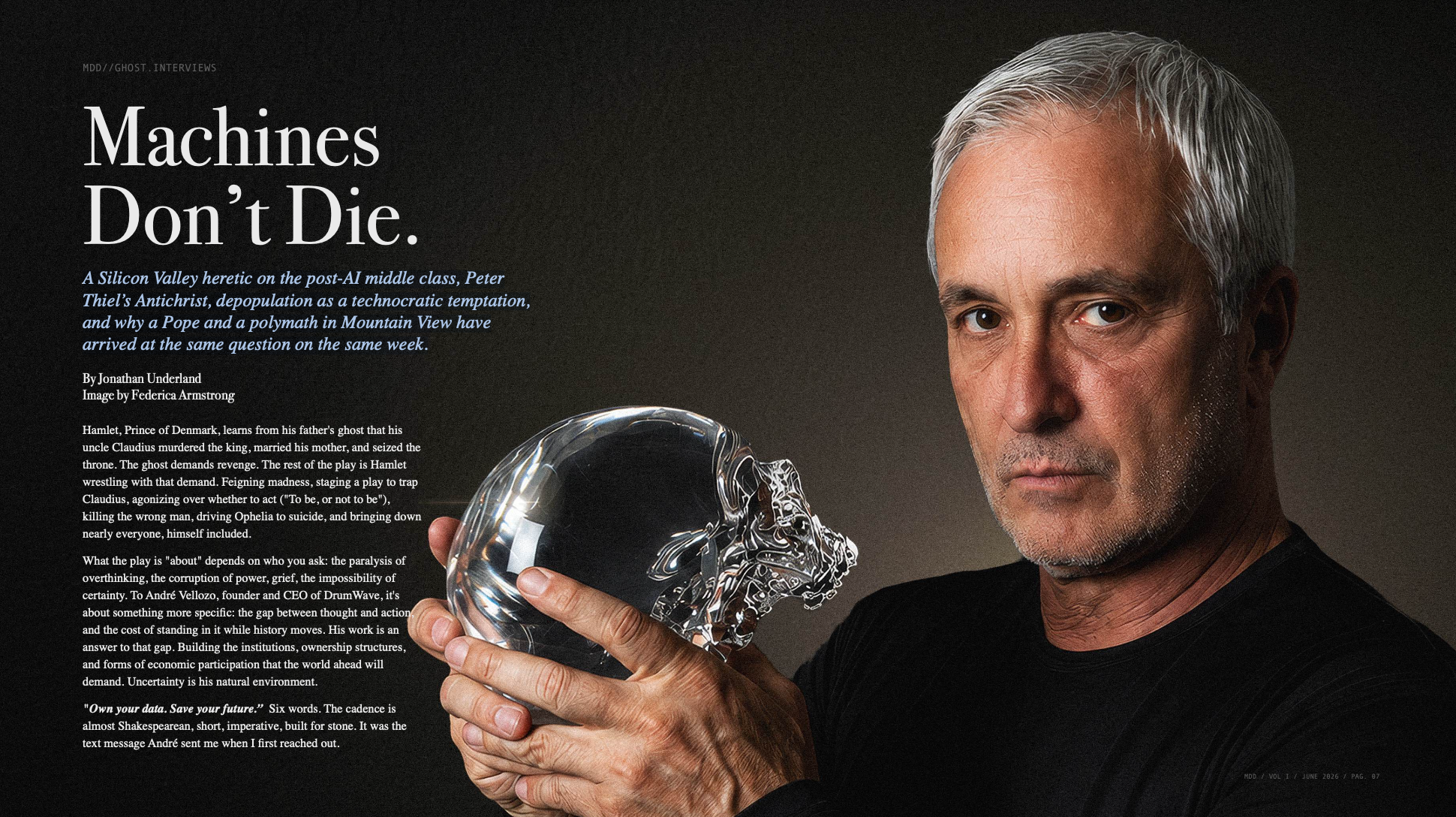
By Jonathan Underland
Image by Federica Armstrong
Hamlet, Prince of Denmark, learns from his father's ghost that his uncle Claudius murdered the king, married his mother, and seized the throne. The ghost demands revenge. The rest of the play is Hamlet wrestling with that demand. Feigning madness, staging a play to trapClaudius, agonizing over whether to act ("To be, or not to be"),killing the wrong man, driving Ophelia to suicide, and bringing down nearly everyone, himself included.
What the play is "about" depends on who you ask: the paralysis of overthinking, the corruption of power, grief, the impossibility of certainty. To André Vellozo, founder and CEO of DrumWave, it's about something more specific: the gap between thought and action, and the cost of standing in it while history moves. His work is an answer to that gap. Building the institutions, ownership structures, and forms of economic participation that the world ahead will demand. Uncertainty is his natural environment.
"Own your data. Save your future.” Six words. The cadence is almost Shakespearean, short, imperative, built for stone. It was the text message André sent me when I first reached out.
The valet at the Rosewood Sand Hill greets every Tesla like a returning son. It is a warm Thursday in May, and the foothills west of Sand Hill Road are doing that California thing where the light forgets it is a Thursday at all. I am here because, by accident of the calendar, two men on opposite ends of the world are answering the same question this week and arriving at startlingly different conclusions.
One is in Rome. Tomorrow morning, Pope Leo XIV is expected to sign his first encyclical, Magnifica Humanitas, the Vatican’s most direct intervention to date on artificial intelligence and labor. He has chosen the date with theatrical precision: the 135th anniversary of Rerum Novarum, Leo XIII’s 1891 letter on industrial capitalism. The new Leo, an American, a mathematician, is staking his papacy on the proposition that AI is the second industrial revolution and that the Church must speak again.
The other man is here, in Menlo Park, ordering an iced tea.
“I don’t drink at lunch,” André Vellozo says, almost apologetically. He has the bearing of a long-distance runner who has decided this morning that he is, in fact, running today. Grey hair is worn slightly long. A dark brown T-shirt under a dark jacket. No watch. He has the most expensive accessory in Silicon Valley: the absence of a third-party logo on anything he wears.
He has just flown back from Los Angeles, where he participated in a panel on The Tech Supercycle at the Milken Conference 2026, alongside policy-makers, central bankers, pension funds, investors, and a few well-dressed monks. He arrives at Madera, the restaurant at the Rosewood, with the specific tiredness of a man who has spent a week being interpreted in three languages. He picks a corner table without consulting me. The wall behind him is glass. Beyond it, Sand Hill Road, the half-mile of low office parks that for two decades was the most concentrated address of capital on Earth.
I ordered the burrata. He orders the grilled branzino, no starter. We split a bowl of olives. The room hums quietly with men of a certain age in unbranded fleeces, the uniform of people who do not need to introduce themselves.
I begin with the easy thing. The story he tells about rideshare drivers.
He smiles. It is the smile of someone who has told it a hundred times and still likes it.
“Somewhere in this city right now, a man is paying for the car, the gas, the insurance, the data plan, the phone. He thinks he is earning a wage. He is paying, out of pocket, to train the autonomous vehicle that will replace him. He is the most expensive customer the AI industry has, and he is invisible to it.” A waiter sets down the olives. André does not touch them. “And the phone in your pocket is not a product you bought. It is a meter. You are paying the energy bill on a sensor that pumps your behavior into the cloud, twenty-four hours a day. Everyone is. We are all financing the revolution that replaces us, and the rideshare driver is just the one whose receipt is visible.”
He says this in the calm tone of a man describing the weather.
It is the central image in a short manifesto he published this month, The Rise of the Post-AI American Middle Class. The argument is straightforward and, depending on your priors, either obvious or eccentric. AI is hollowing out the middle of the labor market from both ends at once. The standard policy response, Universal Basic Income, is, in Vellozo’s reading, a counsel of despair: a monthly check that quietly confirms the worker has nothing left to contribute. He proposes the opposite. A Data Savings Act, modeled on the 1950 Treaty of Detroit, which converted hours of factory labor into pensions and gave the postwar American middle class the asset base it later spent the rest of the century mortgaging. Same problem, new century, new asset.
“Pensions did not solve the industrial economy because someone was being kind,” he says. “They solved it because an economy where workers had no stake in its future was an economy permanently at risk of insurrection. The same logic applies now. The asset has changed. The institution has not been built.”
The branzino arrives. He does not look at it.
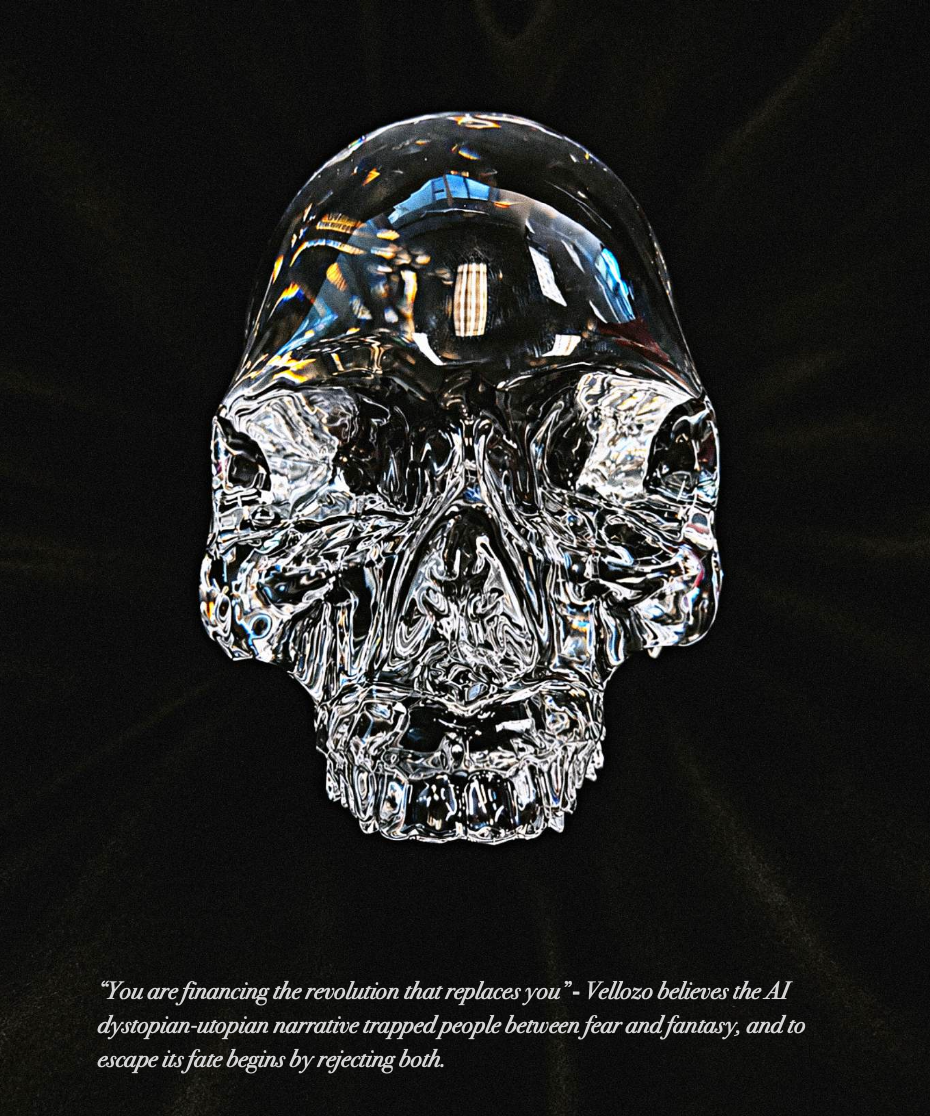
I push back. The “data dignity” idea is not new. Jaron Lanier proposed something similar a decade ago. Glen Weyl and Eric Posner wrote it up in Radical Markets in 2018. Nothing happened. Why does Vellozo think his version lands?
“Two reasons,” he says. He has a Brazilian habit of pausing before he counts, as if listing things in a language he is translating from. “First, the timing. In 2018, the AI agent did not exist. The autonomous fleet did not exist. The Magnificent Seven were worth a third of what they are worth now. The asymmetry was theoretical. Today, it is on the income statement. Open a Bloomberg terminal. Seven companies process the data ‘as a business,’ they host it, refine it, compound it, worth roughly twenty-four trillion dollars. The five largest American banks, plus the two largest card networks, the people who built the entire twentieth-century financial system, are worth around three trillion. There is a twenty-one-trillion-dollar gap between those who process almost all the data and money on the planet. That gap is not an accident.”
He pauses. Picks up the fork. Sets it down without using it.
“Second, the mechanism. Lanier was right about the principle and quiet on the architecture. He proposed compensation. We are building a savings vehicle. The thing about a pension is that it compounds. The thing about a payment is that it is spent. If your data is paid, you are a vendor. If your data is saved, you are an owner. The post-AI middle class, if there is going to be one, will not be salaried into existence. It will be capitalized into existence. We do not need a basic income. We need a basic balance sheet. You keep your money in the bank, and your data is in the cloud. You are free to use your money, and others benefit from your data. If data is an asset, the cloud is unregulated banking.”
The branzino has gone cold. I gesture at it. He looks at it, mildly surprised, and begins to eat. It is at this point that I commit a small anthropological mischief. I ask about Peter Thiel.
Last September and October, Thiel delivered four off-the-record lectures in San Francisco on the figure of the Antichrist. The talks have since been leaked, recapitulated, re-given in Cambridge, and most recently dragged to within walking distance of the Vatican in March. The provocation is theological, but the target is policy. TheAntichrist, in Thiel’s framing, comes to power by talking nonstop about Armageddon, offering peace and safety while building a one-world surveillance system to deliver them. Climate alarmism, AI doomerism, and financial transparency regimes, Thiel folds them all into a single eschatology of overregulation. The legionnaires of the Antichrist, he says, include the safety researchers.
Vellozo is Catholic. Brazilian Catholic, which is a different country from American Catholic. And he hangs out with Buddhists on a daily basis, I ask him what he makes of it.
He chews slowly.
“Three thoughts,” he says, there is a pause again, “and they are uncomfortable.”
“The first is that Peter is doing something theologically serious, and I respect that. He is reading Girard and Newman in a town that mostly reads Andreessen. There is a long tradition in Catholic thought that asks: when the secular state begins to promise salvation, is it still secular? Carl Schmitt called this ‘political theology’. Peter is doing political theology. That is more than the rest of his industry is doing.”
He pauses. Sets the fork down again.
“The second is that he is half right and entirely upside down. He is right that any system that monopolizes the moral language of peace and safety is dangerous. He is right that ‘we need a one-world government to manage the AI threat’ is a phrase that ought to make any reader of the twentieth century nervous. But the system he is warning against, the one that knows everything about everyone, that scores you, that consolidates the file, is the system Palantir built. He is warning the West about the architecture he sold. It is a remarkable sermon to preach in a building you built.”
He smiles, but only with the corners.
“The third is the one that I find disturbing. Peter frames the choice as theology versus technology. Faith versus the machine. That is a very old frame. It is also the wrong frame. The real choice is not whether technology is good or evil. The real choice is whether the value the technology creates belongs to the people who generate it, or to the people who own the rails. That is not a theological question. That is a property question. And property is precisely the question that the West, which loves to lecture China about freedom, refuses to answer about data. In China, the state owns it. In the West, we are told we own it, but we do not. The Antichrist Peter is looking for is not a person. It is a missing column on a balance sheet.”
I write that down twice. It is the kind of line he says without raising his voice.
The waiter clears the plates. André orders a double espresso. I ordered a glass of Sancerre because Sand Hill in the afternoon merits it, and because I want to slow him down. He is the kind of interview subject one wants to slow down: he speaks in declarative sentences and rarely meanders, and the things he does not say are interesting.
We come to the difficult part of the conversation, which is what I have come for.
There is, circulating among certain of his peers, a quiet alternative to the post-AI middle-class question. It is the answer his industry rarely says aloud at conferences but says reasonably often in private. It is the answer that the philosopher Alberto Blumenschein, your long-time partner, recently set down in a strange, lyrical short story called The Cure and the Eden Megacycle, which has been passed around. The argument runs roughly as follows. AI and automation can maintain civilization. They can regenerate the planet. The bottleneck in a beautiful world is not technology. It is the population that produces and consumes nothing that the system actually needs. If the species voluntarily declined to a small continuity population of carefully selected stewards, Earth could heal. The vote, in Blumenschein's story, is unanimous to the point of being haunting. The species ends consciously. Democratically. Without violence. There is a young couple at the end of the story, watching a meteor pass. A bumblebee asleep in a flower.
I ask André what he makes of this story.
He sits back.
“I have read it three times,” he says. He stares for a moment at a point above my left shoulder. “It is well written. It is mystical, it is gentle, and it is the most dangerous idea in this valley.”
“Why dangerous?”
“Because it solves a real problem in a way that is morally seductive and politically catastrophic. The real problem is that the relationship between human contribution and economic value has been severed. Once you sever that link, the human becomes a budget line. UBI is the soft version of that, the species is a stipend. The Cure and the Eden Megacycle is the hard version, the species is a museum. They are the same idea at different temperatures.”
He leans forward.
“Notice the move. The story does not say humanity is bad. It says humanity is finished. It says the work is done, and the kindest thing now is the slow exit. That is not a story about ecology. It is a story about a class of people who have run out of imagination for what todo with the rest of us. The technocrats cannot picture a future in which ordinary people generate value, so they have started picturing a future with fewer ordinary people. They will not say this at the conference. They are saying it in the story.”
A long pause.
“And here is what they miss. The planet is not dying because there are too many people. The planet is being mismanaged because there is no instrument for ordinary people to participate in its management. Once you build the instrument, the data savings account, the dWallet, the data fund, the participation problem dissolves. Eight billion people are not a burden. Eight billion data-rich people are the largest balance sheet in history. The Eden Megacycle is what you write when you do not know how to build the instrument. It is the romanticized confession of a failure of design.”
I press him. Tomorrow, Pope Leo XIV signs Magnifica Humanitas. The Pope, a former mathematician, has been saying for a year that the central question of AI is whether the technology serves the common good or accumulates wealth and power in the hands of a few. Does he see Leo XIV and himself working on the same problem?
“On the same problem,” he says, and he does not smile this time, “from very different chairs.”
“Leo is reaching for the language of dignity. Of labor. Of the person. Those are the right words. Rerum Novarum was the right document for 1891 because it located the worker inside an economic order rather than beneath it. Magnifica Humanitas will try to do the same for the user. But here is the limit of moral language. You cannot defend the dignity of the worker if the worker has no instrument of ownership. The 1891 worker had at least his hours, his union card, and eventually his pension. The 2026 user has what? An app store account? A privacy setting? The Pope can name the harm. He cannot, from Rome, build the savings vehicle. Someone has to build the savings vehicle.”
He sips the espresso. Sets the cup down.
“Tomorrow, he signs the encyclical. The next day, someone here has to take the pen the other way and sign the legislation. Otherwise, it is just another beautiful document about a problem nobody has tools for.”
The Sancerre arrives. André continues with his espresso. The room has thinned. There is a man two tables away who has, I suspect, been listening for the last twenty minutes without pretending otherwise. Sand Hill Road has terrible manners. This is one of its charms.
I ask about the data centers.
The new geography of power runs through them. Stargate. The hyperscaler build-out. Microsoft, Google, Amazon, OpenAI, Anthropic, xAI, all pouring tens of billions of dollars into glass-walled warehouses in Virginia, Texas, Phoenix, Querétaro, and the outskirts of Dublin. Each one consumes the energy of a small city. Each one trains models on data that was generated, in part, by you.
André has called this the collision of the three frontiers: political,financial, and digital.
“The data center is the new refinery,” he says. Only because "Oil refineries reorganized geopolitics in the twentieth century because they transformed a raw material into something usable, and whoever owned the refinery owned the gradient. The data center does the same thing. It takes the raw data, your behavior, your speech, your location, your medical history, and refines it into a model. The model is the product. The data center is the chokepoint. Three powers are competing for it. Big Government, because data is now a sovereignty question. Big Finance, because data is now the underwriting question. Big Tech, because data is its supply chain. You — the citizen, the client, the user — are the field where the oil comes from. Nobody in the three towers thinks you should own the field.”
He pulls out a phone, old, scratched, with no case, and lays it screen-up on the white tablecloth.
“This object,” he says, “is the most fascinating accounting fraud of the twenty-first century. You paid for it. You pay the monthly bill. You pay the energy to charge it. You generate its content. You log into its services. And the accounting standard treats it as a consumer good. It is not a consumer good. It is a production asset, and the worker has been miscategorized as the customer. The Treaty of Detroit changed how factories accounted for human time. The Data Savings Act would change how cloud services account for human data. Same financial sleight of hand. Same correction.”
He turns the phone face down again, almost tenderly.
I ask: Are we going to get the Act?
He laughs for the first time. It is a short, unsweetened laugh.
“This is with Washington. I hope first. Washington is presently being absorbed by the valley, which is a separate problem. We launched dWallet and the Data Savings Plan in the United States last year. Brazil moved along because it has a peculiar gift for moving fast on financial infrastructure. Pix. Open banking. The data ownership bill in the Chamber. Brazil is not encumbered by being the incumbent. The United States will accelerate because it always does when the alternative is being lapped by China. The Chinese government is playing what game theorists call an infinite game: keep playing, change the rules, never declare. The West is still in election cycles and quarterly reports. Until the West learns that data ownership is its only structural answer to a centralized data state, it will keep losing in a way it does not yet recognize as losing.”
I mention his line from one of his white papers, that the West is not behind, it is playing to lose. He nods.
“The competitive advantage is not who has the better model. The competitive advantage is that the political system can convert eight billion data producers into eight billion data owners. China cannot do this. China owns the data. The West can do this and has not. The window is roughly five years.”
We are now an hour and forty minutes in. The dining room is almost empty. I steal one of his olives. He has not eaten an olive in forty years, possibly ever.
I ask the last question, which is the personal one. He has been doing this for fifteen years. He has been told by various people in various rooms that he had nothing, that he had only vision, that he was the next Elizabeth Holmes, that he should learn he was nothing, that he was on his way to the guillotine. He has kept a list. It is on page twelve of his portfolio. Why has he stayed?
He thinks about it longer than I expect.
“I do what I do because I accepted the challenge integrally. When you accept something integrally, you cannot half-decline it later. There is no reverse gear on that particular gearbox.” He smiles.“Also, I am Brazilian. We are bad at giving up and worse at apologizing.”
He stands. The light through the window has gone gold; we have crossed into late afternoon. Out on the patio, two men in dark grey vests are arguing about a term sheet. André pauses to zip his jacket.
“Tomorrow, the Pope will sign his letter. Tomorrow I am flying to talk about The Rise of the Post-AI American Middle Class to a room of people. We will be saying the same thing in two different rooms. The thing is this. The economy exists to serve human needs. Without people, there is no demand, no purpose, no value. An AI that extracts value from the species that built it is not efficient. It is parasitic. The cure is not slower AI. The cure is broader ownership. We are all data-poor. We need to become data-rich. That is the entire argument. Everything else is implementation.”
I walk him to the lobby. He has not parked at the valet. He has parked his car himself in a public lot two blocks down, which on Sand Hill Road is a small act of theatre and possibly contempt. He shakes my hand once, briefly, and is gone.
When I sit back down to pay, the man two tables over leans across and says, in the tone of someone who has been holding it in, “Whois that?”
I tell him.
He writes the name on the corner of his napkin.
André Vellozo is the founder of DrumWave and a founding member of the International Data Reserve in Switzerland. His policy brief, The Rise of the Post-AI American Middle Class, was published this month. Pope Leo XIV’s encyclical Magnifica Humanitas is expected to be signed on May 15. Alberto Blumenschein’s The Cure and the Eden Megacycle is circulating privately. The conversation in this piece has been edited for length.